From Hype to Operational Reality
OPIA’s latest PrintPulse Live session moved the AI conversation beyond curiosity and into operational strategy.
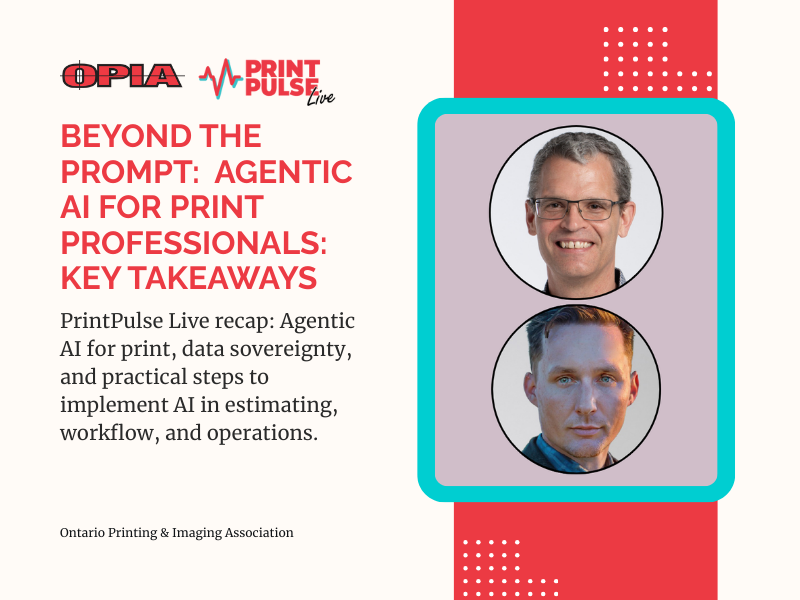
In Beyond the Prompt: Agentic AI for Print Professionals, Lee Eldridge and Christopher Smyth of Toronto Metropolitan University’s School of Graphic Communications Management explored how AI can support estimating, prepress, production planning, and management reporting in real print environments.
The central message was clear: AI is already present in the tools many businesses use. The real question is whether it will be implemented deliberately and securely, or adopted informally without governance.
What Makes Agentic AI Different?
Most print professionals are familiar with general-purpose AI tools that respond to a prompt and generate text. Agentic AI takes the next step.
Rather than producing one-off responses, an AI agent:
- Operates within a defined role
- Works from approved internal data sources
- Follows structured instructions
- Repeats tasks consistently
In practical terms, this means an AI agent can act like a supervised junior estimator, marketing analyst, or production assistant. It can convert unstructured inputs, such as emails, into structured data. It can analyze MIS exports and produce management-ready summaries. It can draft estimates based on predefined pricing tables and margin rules.
However, as emphasized during the session, human oversight remains essential. AI systems can be overly confident and occasionally incorrect. Treating them as supervised team members rather than autonomous decision-makers is critical.
The Importance of Data Sovereignty
A significant portion of the discussion focused on data sovereignty and control.
Uploading client pricing, job data, and internal procedures into public AI systems raises legitimate confidentiality concerns. Lee and Chris highlighted the importance of keeping business-critical data within infrastructure that the organization controls.
For print businesses managing proprietary pricing models, customer data, and operational know-how, protecting intellectual property is not optional. Sovereign AI environments allow companies to build internal capability without exposing sensitive information externally.
A Practical Roadmap for Print Companies
The session concluded with a clear implementation path:
1. Identify one high-value question.
For example: Which jobs exceeded estimated time yesterday? What presses were bottlenecks this month?
2. Map the data.
Determine where relevant information resides and consolidate it in a controlled environment.
3. Define the system prompt.
Every agent requires a clearly written role, purpose, data boundaries, and output format.
4. Pilot and refine.
Start small, run the agent alongside existing processes, and review outputs carefully.
The key advice: focus on structure, not tools. Technology will evolve. A well-defined workflow and data strategy will endure.
Why This Matters Now
Print operations are facing tight margins, complex workflows, staffing challenges, and growing client expectations. Agentic AI for print is not about replacing people. It is about removing repetitive, non-value-added tasks and freeing teams to focus on higher-level decisions.
As demonstrated in this session, the opportunity lies in structuring the unstructured and embedding AI within governance frameworks that align with the realities of print production.
PrintPulse Live continues to explore timely issues shaping Ontario’s print and graphic communications industry. Watch for additional resources and future webinars in the series.