Moving from Concept to Real-World Application
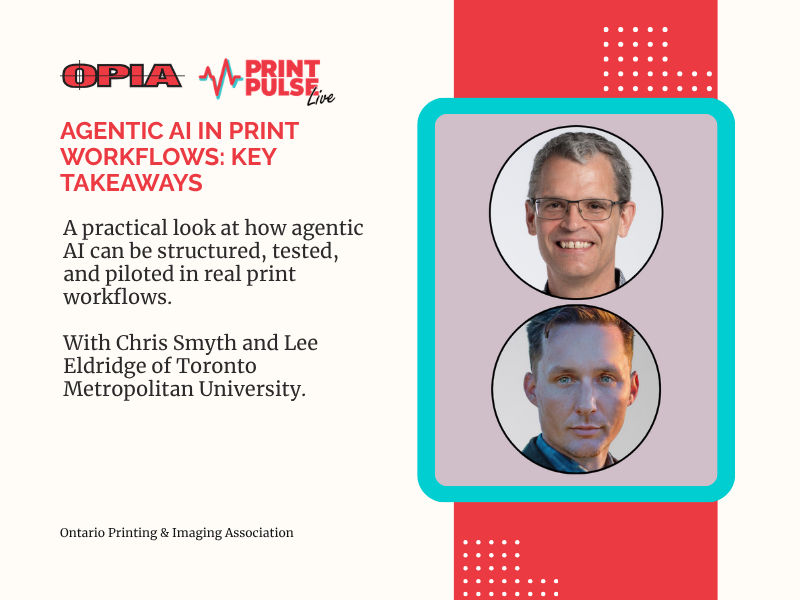
OPIA’s PrintPulse Live session on March 25 took the next step in the AI conversation, focusing on how to move from theory into practical implementation. In Agentic AI in Print Workflows: Live Demo, Guardrails, and Pilot Planning, Christopher Smyth and Lee Eldridge demonstrated what an AI pilot actually looks like inside a print operation.
Building on their earlier session, the focus was clear: AI is already present in many workflows, but the real opportunity lies in structuring it properly, testing it carefully, and deploying it with governance.
What an AI Agent Actually Does
The session reinforced that agentic AI is not a general-purpose chatbot. It is a defined system built around three core elements: role, data, and rules.
In the live demo, an AI agent was configured as a junior estimator, using structured data such as pricing tables, stock options, and finishing costs. The agent processed a real-world print request, broke it down into production steps, and generated a detailed estimate.
This demonstrated how agentic AI can:
- Convert unstructured inputs into structured job data
- Apply consistent rules to estimating and production decisions
- Provide transparent reasoning and confidence levels
- Reduce repetitive manual tasks
At the same time, the presenters emphasized that these systems must be treated like supervised junior staff, not autonomous decision-makers.
Structured vs. Unstructured Data
The workshop explored two common use cases for agentic AI in print:
- Structured data workflows, such as estimating, where defined tables and rules drive consistent outputs
- Unstructured data workflows, such as email triage, where agents extract job specifications from incoming client communications
In one example, an agent reviewed incoming emails and converted them into structured job specifications, identifying missing information and assigning confidence scores. This type of application can significantly reduce time spent on repetitive administrative tasks.
Why Guardrails Matter
A key theme throughout the session was governance.
While AI systems can deliver strong results, they are not perfect. Errors, assumptions, and inconsistencies can occur, especially when inputs are incomplete or ambiguous.
To manage this, the presenters highlighted several guardrails:
- Limit access to approved data sources
- Restrict unnecessary capabilities such as web browsing
- Log and review reasoning steps for validation
- Require human oversight for critical outputs
- Protect sensitive customer and operational data
Without these controls, informal AI adoption can introduce risk rather than efficiency.
A Practical Pilot Approach
For organizations looking to get started, the session outlined a clear pilot framework:
- Define what success looks like and how it will be measured
- Collect real examples of inputs such as emails or job requests
- Build a simple agent with a clearly defined role
- Test in a controlled environment alongside existing processes
- Refine iteratively based on patterns, not one-off errors
The advice was consistent: start small, change one variable at a time, and build confidence before expanding.
From Productivity to Operational Impact
Initial AI implementations often deliver individual productivity gains, such as reducing manual data entry or email processing time.
The larger opportunity comes when agents are connected into workflows. For example, an email triage agent can feed structured data into an estimating agent, which then outputs a draft quote for review. This is where true operational efficiency and error reduction begin to take shape.
Why This Matters for Print Businesses
Print operations are complex, data-driven, and often constrained by time and labour. Agentic AI in print workflows offers a way to standardize processes, reduce manual effort, and improve consistency across estimating, production, and customer communication.
However, as demonstrated in this session, success depends less on the technology itself and more on how it is structured, governed, and integrated into existing workflows.
PrintPulse Live continues to explore practical, real-world applications of emerging technologies. Watch for future sessions as OPIA brings together industry experts to address the challenges and opportunities shaping Ontario’s print and graphic communications sector.
Watch the webinar video on the OPIA YouTube channel here: https://youtu.be/NpnN-ww5B6o